

Business Continuity Management (BCM)
Core Advantages:
- Rapid Deployment: Ready-to-use screens, workflows, and data integration mechanisms allow for immediate production use or serve as a foundation for tailored workshops.
- Expert Knowledge Base: The system is not just a tool; it embodies best practices and methodologies developed by specialists over 10+ years.
- Integrated Relationship Model: At its core is a powerful mapping of Business (Processes) – Resources – Technology, allowing for a precise understanding of dependencies.
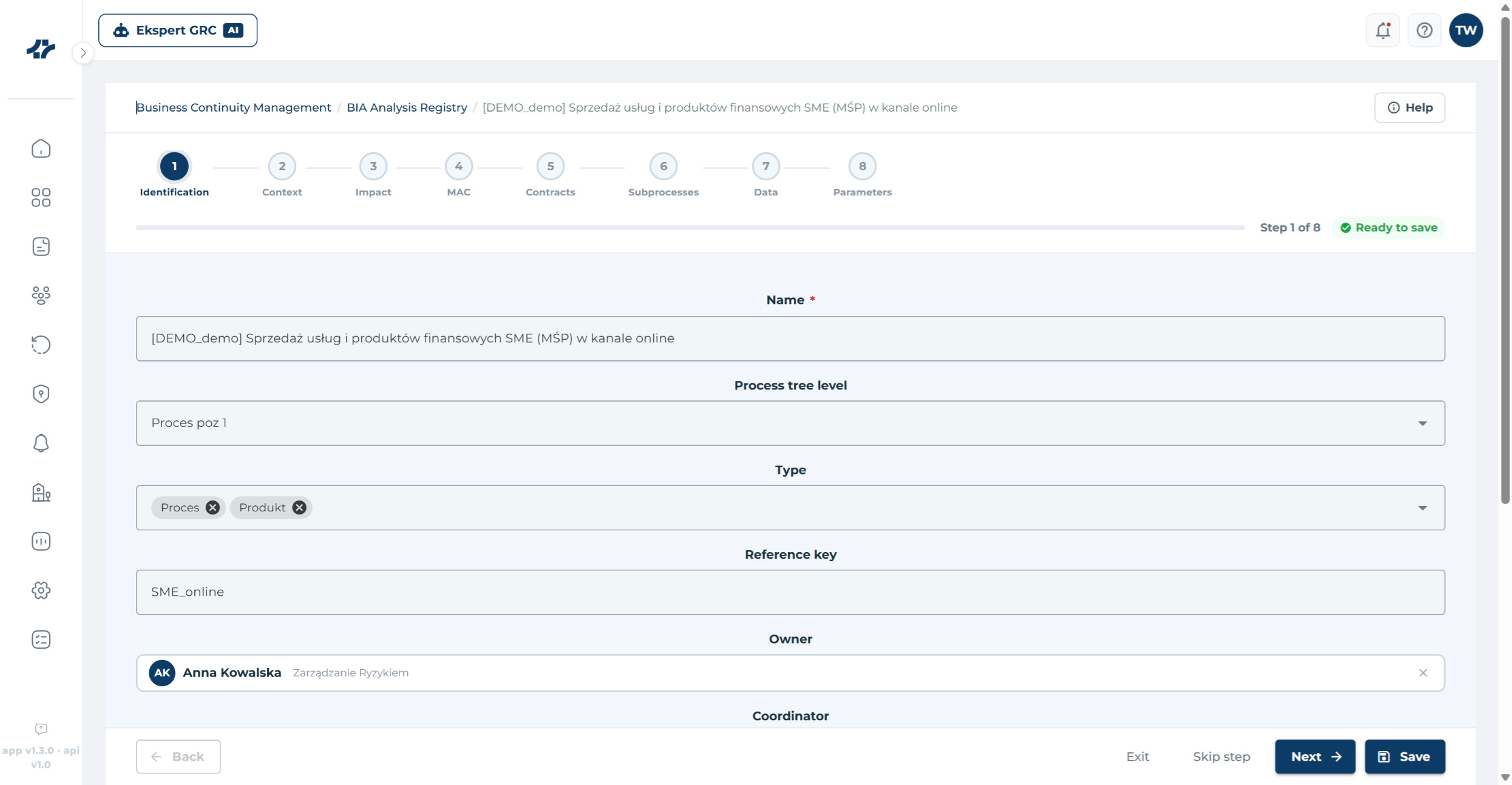
Business Impact Analysis
Know what breaks first – and what it costs you per hour.
Map every critical process to its dependencies, set RTO, RPO and MTPD, and quantify impact in terms your board acts on. The foundation every recovery decision is built on.
- Process catalogue with RTO / RPO / MTPD and financial + operational impact
- Dependency mapping across systems, people, sites and third parties
- AI pre-fills the BIA from existing data – your analyst confirms
- Criticality scoring that drives recovery priorities automatically
- ISO 22301-aligned, audit-ready, full version history
Recovery Planner
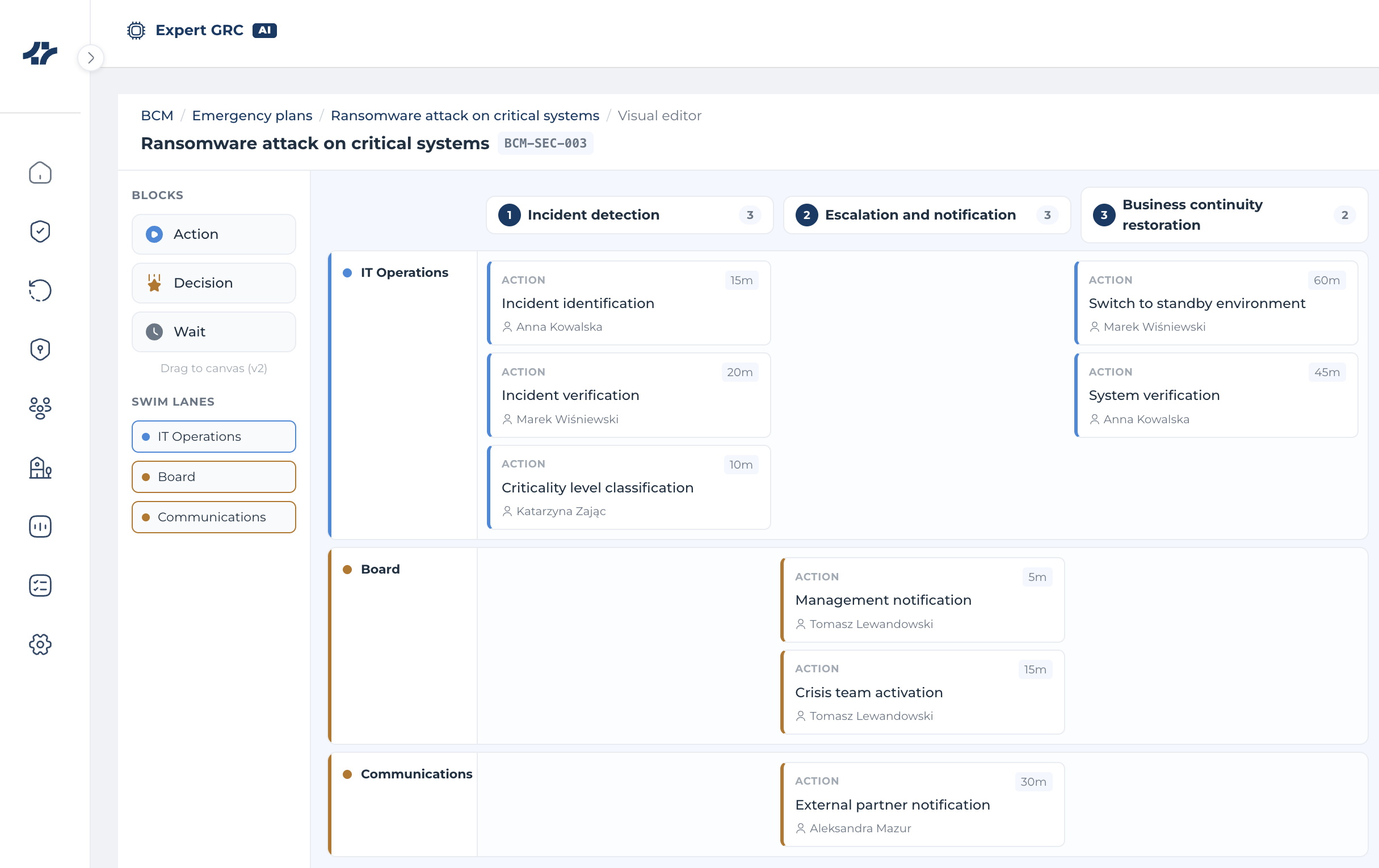
Plans tied to real dependencies – current the day disruption hits.
Turn the BIA into actionable recovery strategies: who does what, in what order, with which resources, against the RTO that matters. Not a template binder – a living plan with owners and review cycles.
- Recovery strategies linked directly to BIA dependencies and RTOs
- Step-by-step procedures with assigned owners and resources
- Disaster recovery and IT continuity coverage
- Gap detection: flags processes with no viable recovery path
- Automatic review cadence and approval workflow with audit trail
Key Functional Areas:
- Comprehensive Inventory: Access a central repository of organizational intelligence, including business processes, services, resource requirements, organizational structures, emergency teams, and backup locations.
- Guided BIA (Business Impact Analysis): A fully parameterizable wizard leads users step-by-step through determining process criticality, recovery time objectives (RTO), and the Minimum Acceptable Configuration (MAC) for essential resources.
- Advanced Risk Assessment: Evaluate risks across multiple dimensions—by process, by resource (IT, personnel, vendors), or by organizational unit. Link potential losses directly to BIA data for better decision-making.
- Smart Emergency Procedures: An intelligent repository for managing the lifecycle of plans and procedures. Features include a version comparator to easily track, approve, or reject changes between current and draft versions.
- Scenario-Based Action Plans: Define specific response scenarios based on event type, probability, and impact. Scenarios can be linked hierarchically (e.g., regional to national levels) and trigger automated notifications upon activation.
- BCM Testing & Recommendations: Transform plans into proven strategies. Schedule and manage tests for any combination of procedures, processes, or resources. Assign, monitor, and track post-test recommendations through a dedicated workflow.
Resilience Testing
Exercise the plan before reality does.
Plan, run and document tabletop exercises and scenario tests – then feed findings straight back into BIAs and recovery plans. Proof of operational resilience your auditor and regulator can see.
- Tabletop exercises and disruption scenario simulations
- Structured findings and action tracking to closure
- Results loop back into BIA and recovery plans automatically
- Exercise evidence and reports for ISO 22301 / DORA testing obligations
- Schedule and track a continuous testing programme, not one-off drills